
Beyond the Framework: Shu–Ha–Ri and Real Agile Maturity
Agile transformation is often presented as a change in processes, tools, and ways of working. Organizations introduce new ceremonies, redesign workflows, configure Jira boards, and train employees in frameworks such as Scrum or Kanban.
These changes are visible, measurable, and relatively easy to implement.
The more difficult transformation happens elsewhere.
It takes place in the way leaders make decisions, distribute authority, respond to uncertainty, and use evidence. Ceremonies can be introduced within weeks. Building professional judgment, genuine autonomy, and evidence-based leadership can take considerably longer.
This is why an organization may appear Agile without developing meaningful Agile capability.
When Agile Becomes a Collection of Activities
Many transformations begin with understandable intentions. Leaders want greater transparency, faster delivery, improved collaboration, and a stronger focus on customer value.
However, the transformation can gradually become centered on activities rather than outcomes:
- more ceremonies;
- more templates;
- more Jira fields;
- more dashboards;
- more meetings with Agile names.
The organization may be able to demonstrate that every team holds a Daily Scrum, conducts Sprint Reviews, and maintains an updated backlog.
Yet the underlying system remains unchanged.
Decisions are still slow. Teams remain overloaded. Priorities change without explanation. Employees continue to wait for approval from people who are distant from the work. Leaders measure the number of completed tasks rather than the value created for customers.
A team can follow Scrum precisely and still be anything but Agile.
The presence of an Agile framework does not automatically create Agile leadership, Agile decision-making, or organizational adaptability.
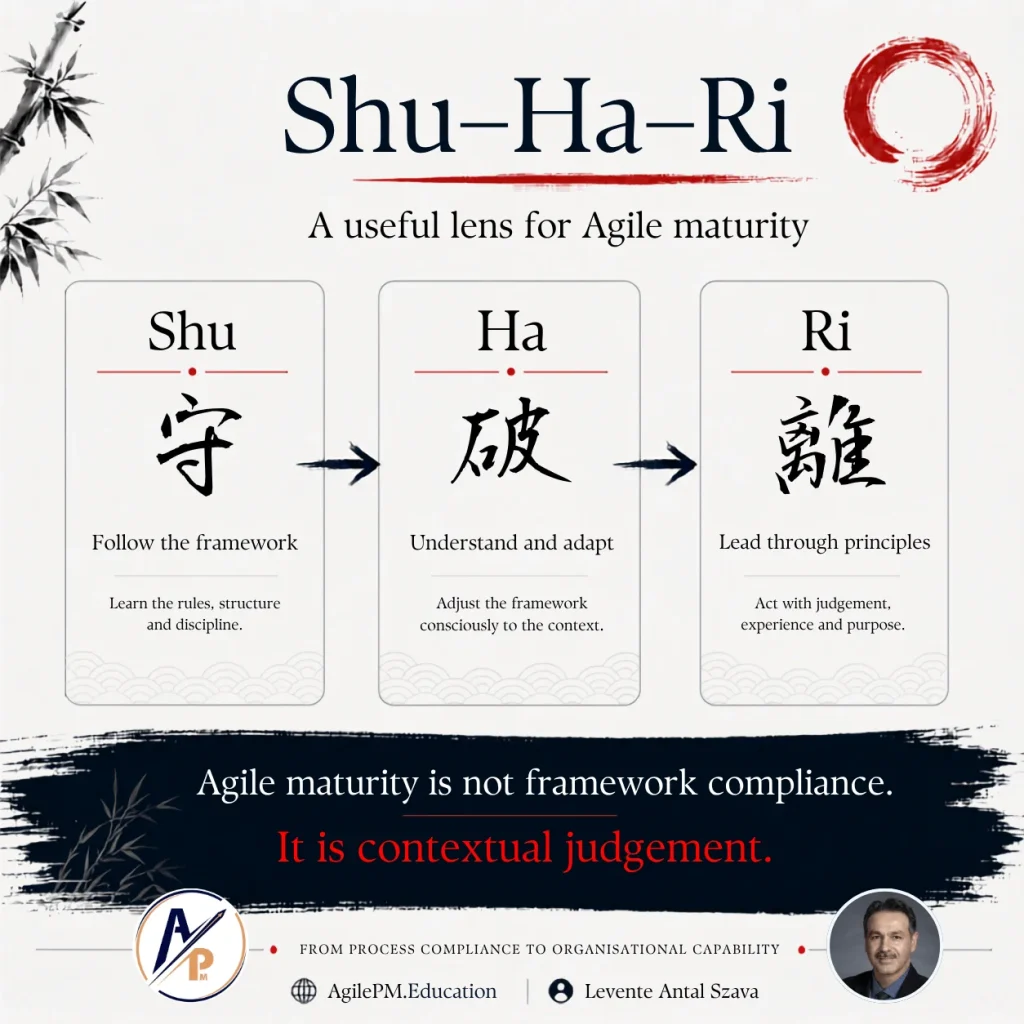
Understanding Agile Maturity Through Shu–Ha–Ri (守 破 離)
The Japanese concept of Shu–Ha–Ri provides a useful way to understand how individuals and organizations develop mastery. The concept originates in Japanese martial arts and describes progression from following a form, through adapting it, to acting beyond it through internalized principles and judgment.
Shu (守) — Follow the Form
At the Shu stage, people learn the rules, structures, and disciplines of a practice.
In an Agile environment, this may involve learning how to:
- structure a backlog;
- conduct a Daily Scrum;
- plan a Sprint;
- facilitate a Retrospective;
- define roles and responsibilities;
- make work visible.
This stage is necessary. Teams need a shared foundation before they can adapt a framework responsibly.
The problem arises when the organization begins to treat Shu as the final destination.
A transformation cannot be considered mature merely because meetings occur on schedule or teams follow prescribed practices.
Ha (破) — Adapt the Form
At the Ha stage, people begin to understand why the rules exist.
Instead of applying a framework mechanically, teams adapt it consciously to their environment. They preserve the underlying principles while modifying practices to address the needs of their customers, products, and organizational context.
The important distinction is that adaptation is not arbitrary.
Teams do not abandon discipline simply because a practice feels inconvenient. They use experience, evidence, and reflection to determine what should be changed and why.
At this stage, leaders must also begin to change their behavior.
They need to clarify decision boundaries, reduce unnecessary approvals, and allow teams to act on information that emerges during delivery. They must create an environment in which learning can influence priorities and plans.
Ri (離) — Transcend the Form
At the Ri stage, principles have become internalized.
Teams and leaders no longer depend on mechanical compliance to guide every action. They can make responsible decisions based on purpose, evidence, experience, and professional judgment.
The framework remains useful, but it is no longer treated as a substitute for thinking.
This does not mean that processes disappear. It means that processes serve the work rather than control it.
The Risk of Remaining in Shu
Many organizations never move beyond the first stage.
The Daily Scrum takes fifteen minutes. The Sprint Review happens on schedule. The board is updated. Every task has an owner, status, and estimate.
From the outside, the transformation appears successful.
But beneath the surface:
- people still wait for approval;
- teams cannot challenge unrealistic priorities;
- managers continue to allocate work directly;
- new information does not influence strategic decisions;
- employees are held accountable for outcomes without receiving sufficient authority;
- success is measured through output rather than customer or business value.
This is not Agile maturity.
It is process compliance wearing Agile language.
The organization has adopted the visible form of Agile without developing the leadership capabilities required to support it.
What Real Agile Maturity Looks Like
Real Agile maturity is not demonstrated by the number of ceremonies conducted or user stories completed.
It becomes visible in the organization’s ability to:
Make Decisions Under Uncertainty
Agile organizations do not wait for complete information before acting. They make proportionate decisions, test assumptions, and adjust their direction when new evidence becomes available.
Expose Problems Early
Teams feel able to communicate risks, delays, and failed assumptions before they become crises. Transparency is treated as a source of learning rather than a reason for punishment.
Adapt Without Losing Purpose
Agility does not mean reacting to every new request. Mature organizations distinguish between purposeful adaptation and constant disruption.
Changes are evaluated against strategic goals, customer outcomes, and available capacity.
Balance Autonomy With Accountability
Autonomy does not mean the absence of boundaries.
Teams need clarity about the outcomes for which they are responsible, the constraints within which they can operate, and the decisions they are authorized to make. Accountability becomes meaningful when people also have the authority and information required to act.
Improve Measurable Outcomes
Activity is not the same as progress.
Velocity, story points, and completed tasks may support operational conversations, but they do not prove that value has been created. Mature organizations connect delivery work to measurable customer, employee, and business outcomes.
The Framework Is Not the Destination
Frameworks matter.
They provide structure, shared language, and practical guidance. They help teams establish discipline and make work visible. For organizations beginning their Agile journey, this foundation is essential.
But the framework is not the destination.
The purpose of Agile is not to produce better followers of a process. It is to develop stronger organizational capability.
That capability includes the ability to learn, decide, adapt, and deliver value under changing conditions.
The real question, therefore, is not whether an organization is performing Agile ceremonies correctly.
The more important questions are:
- Can teams make timely decisions?
- Can evidence challenge existing plans?
- Can employees raise problems without fear?
- Can leaders change direction when assumptions prove incorrect?
- Can the organization balance autonomy, accountability, and strategic alignment?
These questions reveal more about Agile maturity than any ceremony-adoption dashboard.
Where Is Your Organization Today?
Is your organization in Shu, following the framework and building discipline?
Has it reached Ha, adapting practices consciously while preserving their purpose?
Is it moving toward Ri, operating through principles, experience, and professional judgment?
Or is it still calling process compliance Agile maturity?
Agile transformation becomes meaningful when it changes not only how teams organize their work, but also how the organization thinks, learns, and makes decisions.
Read the original LinkedIn post and join the conversation there.
Share on